





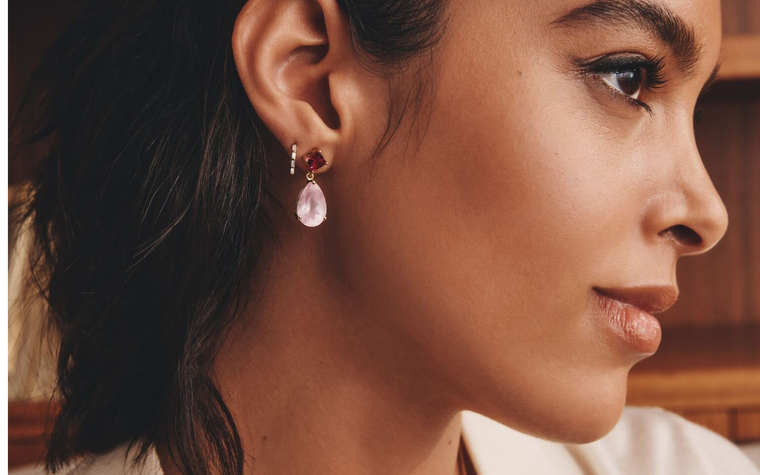
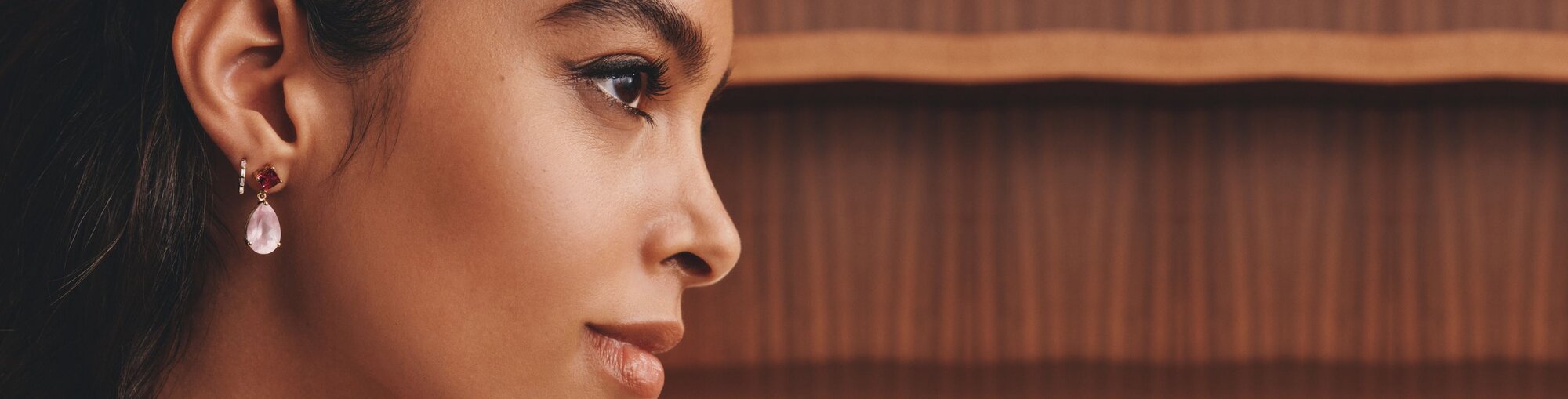
Expertise you can trust: Brilliant Earth is known for its award-winning jewelry designs and seamless, innovative shopping experience. This Brilliant Earth jewelry guide provides step-by-step instructions for building an earring stack. All Brilliant Earth guides are meticulously researched and reviewed by our certified gemologists, content, editorial, and brand teams before publication to ensure industry-leading excellence and accuracy.
How to Stack Earrings for Multiple Piercings
A successful earring stack depends on more than simply filling every piercing. The strongest combinations consider visual hierarchy, the spacing between piercings, and how the earrings relate to one another. Here's a step-by-step approach to creating a balanced stack.
1. Choose a Focal Earring
Start with the earring you want the eye to notice first. Once that's clear, the remaining pieces can support it instead of competing with it. The focal earring does not necessarily need to be the largest piece. Sparkle, color, shape, movement, or an unusual silhouette can also draw attention.
Every other earring in the stack can be given its own role, so each piece contributes something different rather than competing for the same attention:
- Focal point: The piece that attracts attention first.
- Foundation: A versatile stud, hoop, or huggie that establishes the stack’s structure.
- Contrast piece: An earring that introduces a different shape, texture, metal, or gemstone.
- Connector: A piece that repeats an element elsewhere in the stack, tying the other earrings together.
Not every stack needs all four roles. The principle is simply to make sure each added earring contributes to the overall composition.

2. Work With Your Piercing Placement
Your piercings determine the available space for the stack, so evaluate their position before deciding which earrings go in which piercing.
Look at:
- The spacing between piercings and how much ear is visible between them
- The angle of each piercing
- The shape and curve of the ear
Our jewelry specialists recommend judging the visible relationship between the earrings, rather than trying to follow a fixed formula based only on the number of piercings.

3. Balance Visual Weight
Visual weight describes how much attention an earring commands. Size matters, but so do diamonds, gemstones, movement, metal width, shape, and level of detail.
One common way to manage visual weight is a size progression: placing a larger earring in the first lobe piercing and gradually smaller pieces higher on the ear. The progression doesn't need to be perfectly graduated. A small earring can sit next to a larger one when another feature, like shape or spacing, creates separation. Think of it as a tool for creating hierarchy, not a rule every stack must follow.
When building a stack:
- Let one piece carry the most visual weight.
- Use simpler earrings around highly detailed designs.
- Avoid placing several visually dominant pieces so close together that none has room to stand out.
- Consider the stack as a whole rather than evaluating the size of each earring independently.
Our jewelry specialists recommend focusing on visual balance rather than earring count. Three substantial earrings can look fuller than five delicate pieces.

4. Add Contrast
Contrast helps individual earrings remain visible within a multi-piercing arrangement. You can create it through:
- Scale: Combine larger and smaller earrings.
- Shape: Mix studs, hoops, huggies, drops, climbers, or other silhouettes.
- Texture: Pair polished metal with diamonds, gemstones, or more detailed surfaces.
- Movement: Combine stationary earrings with a piece that drops or moves.
- Metal: Mix yellow gold, white gold, rose gold, platinum, or silver.
- Color: Introduce gemstones or other colored details among neutral metal or diamond pieces.
You do not need to vary every element. One or two differences are often enough to give the stack dimension.

5. Repeat an Element for Cohesion
Contrast separates the earrings visually, while repetition connects them.
You can repeat:
- A metal color
- A diamond or gemstone detail
- A geometric shape
- A hoop silhouette
- A similar setting style
- A shared design motif
For example, a stack might include earrings of different sizes and shapes but repeat yellow gold throughout. A mixed-metal stack could instead use diamonds as the connecting element.
Think of earring stacking as a balance between contrast and repetition. Contrast creates definition, and repetition creates cohesion.

6. Evaluate the Full Stack
Once the earrings are in place, look at the ear as one composition, both how it looks and how it physically sits.
Start with physical fit. Check whether:
- Hoops overlap or knock against each other
- A drop or charm catches on a neighboring earring
- Two studs visually merge because the piercings are close together
- An earring presses uncomfortably against another piece, or backs don't have enough room behind the ear
Then step back and ask:
- Is there a clear focal point?
- Can you distinguish the individual earrings?
- Does the scale feel balanced from one piercing to the next?
- Does each earring add something different?
If the stack feels crowded, replace one detailed piece with a simpler earring or leave a piercing open. If it feels disconnected, repeat a metal, gemstone, shape, or other design detail.
A strong earring stack usually has a clear hierarchy: one element leads, supporting pieces create dimension, and enough spacing allows each design to remain recognizable.

Styling Tips
Once the overall structure works, smaller styling choices can refine the stack.
- Mix metals with a connecting detail. Yellow gold, white gold, rose gold, platinum, and silver can work together. Repeating diamonds, gemstones, shapes, or another design feature can help different metals feel connected.
- Consider both ears together. Your earring stacks do not need to match. One ear can carry more visual weight while the other uses fewer or simpler pieces. Look for overall balance rather than perfect symmetry.
- Change placement before changing the entire stack. If a combination feels slightly off, rearrange the existing earrings first. Moving a focal piece or placing a simple stud between two detailed earrings can change the visual balance significantly.
- Prioritize comfort. Multiple earrings can add both physical and visual weight. The stack should feel comfortable at the piercing sites, and neighboring pieces should not repeatedly press or pull against one another.
The best earring stacks balance hierarchy, progression, spacing, contrast, and repetition. Use those principles as a starting point, then adjust the combination to suit your piercings, ear anatomy, and personal style.
FAQ
How do you stack hoop earrings?
To stack hoop earrings, vary their diameter, width, or level of detail so each hoop remains visually distinct. A larger hoop typically anchors the lower lobe, with smaller hoops or huggies creating progression higher on the ear. Mixing plain metal with diamond, gemstone, or textured hoops adds contrast, and leaving enough space between adjacent hoops prevents them from overlapping or knocking together. Hoops do not need to decrease in size perfectly as they move up the ear, only to maintain a clear relationship to one another.
How do you stack multiple earrings?
To stack multiple earrings, choose one focal piece and build around it with earrings that vary in size, shape, texture, or detail. Add a supporting stud, hoop, or huggie, then introduce contrast through shape or texture and repeat one element to connect the pieces. Check spacing and overall visual weight across the full ear rather than styling each piercing in isolation. If an additional earring makes the pieces harder to distinguish, the stack works better without it.
How many earrings should be in an earring stack?
There is no ideal number of earrings in a stack. The right count depends on piercings, ear anatomy, earring size, spacing, and the visual weight of each piece. Two substantial hoops and a statement stud can look fuller than several small, delicate earrings. A stack has enough pieces once it feels complete without making individual earrings hard to distinguish.
What are the best earrings for stacking?
The best earrings for stacking are styles that fit the available piercing space and contribute a clear role to the arrangement. Studs and diamond studs work well as compact foundations, huggies and hoops add shape and sometimes movement, and gemstone, drop, charm, climber, or crawler earrings add color, movement, or a natural focal point. The strongest combinations mix earring types rather than repeating the same shape and scale throughout the stack.
Should both ears have the same earring stack?
No. Asymmetrical stacks can use different earrings or different counts on each ear and still look balanced. Instead of mirroring the ears, compare their overall visual weight. If one ear carries a larger hoop, drop, or detailed earring, the other can use a smaller grouping of simple studs or huggies to match it in weight rather than in design. Repeating one feature across both ears, such as the same metal tone, a diamond detail, or a shared shape, creates a visual connection between the two sides without requiring them to match piece for piece.
How do you stack stud earrings?
To stack stud earrings, vary their size, shape, or level of detail so individual studs do not visually merge. A larger or more distinctive stud can serve as the focal point, with smaller designs supporting it. Contrast can come from diamond and plain metal studs, different gemstones, round versus geometric shapes, or varying stone sizes. When piercings sit close together, smaller studs help preserve visible space between designs.
How do you stack gold and silver earrings?
To stack gold and silver earrings, repeat the metal tones or connect them through another shared feature, since mixed metals read most cohesively when the contrast is part of a broader pattern rather than one isolated piece. This can mean repeating both metal colors across several piercings, using a mixed-metal earring as a connector, or repeating diamonds or gemstones across different metals. The metals do not need to appear in equal amounts, since repetition and visual connection matter more than exact symmetry.
How do you make an earring stack look balanced?
To make an earring stack look balanced, distribute visual weight across the ear and give the most detailed pieces enough room to stand out, without requiring every earring to match in size or both ears to mirror each other. Balance depends on four factors: hierarchy (which earring leads), scale (the mix of large, medium, and small elements), spacing (avoiding crowded piercings), and repetition (connecting pieces through metal, stones, or shape). If every piece competes equally for attention, simplifying one part of the stack usually creates a stronger balance.
